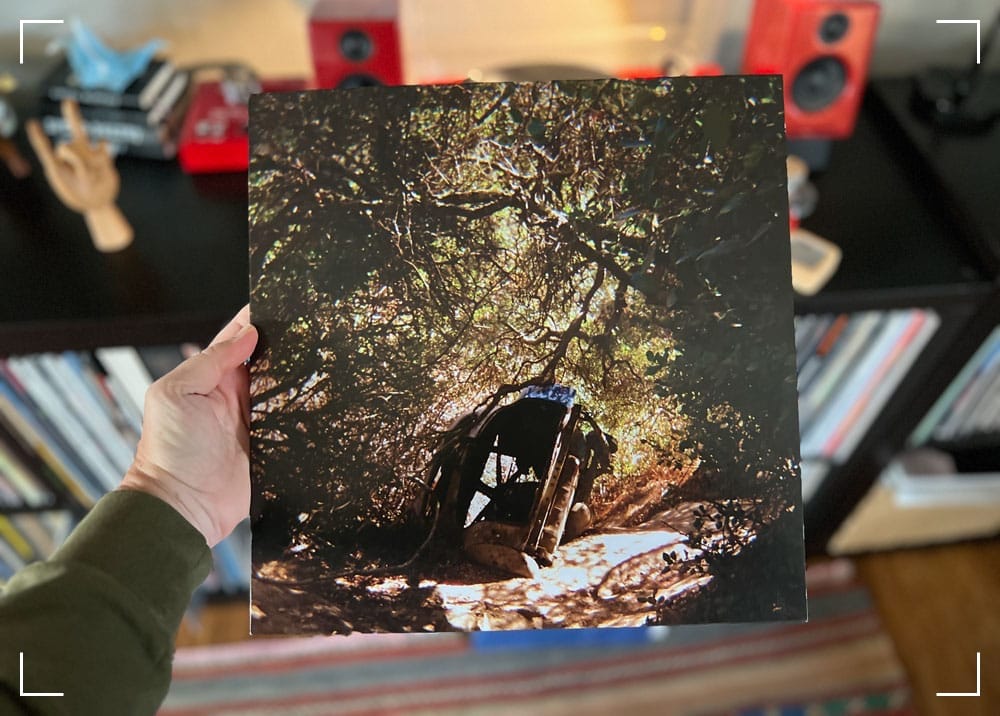
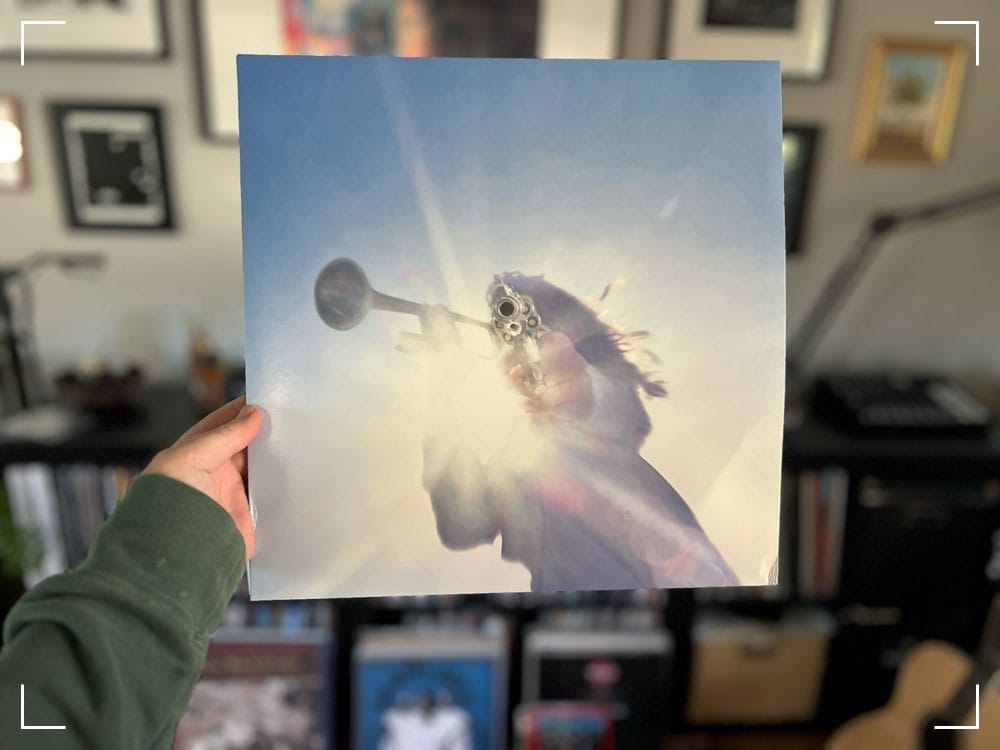
It's The Vinyl Countdown: #4 "Cancionera" by Natalia Lafourcade
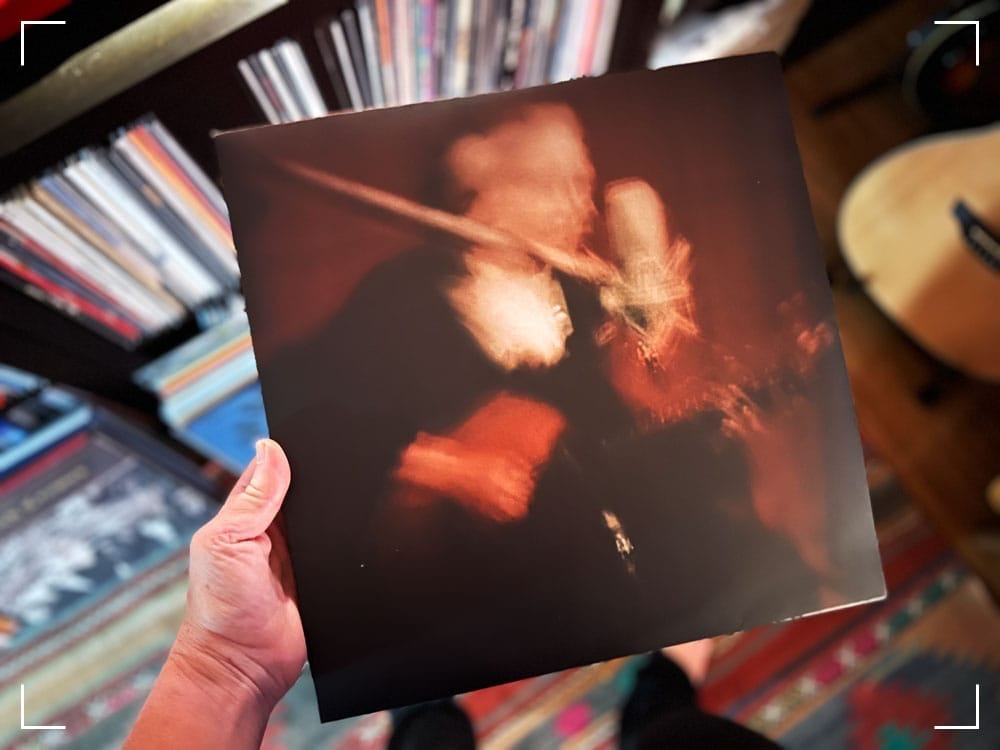
“I don’t know what this lady is saying, but I think I love her.”
– My brain, talking to itself
Oh, the weather outside is… biblical. As I write, drops of rain the size of house bricks are hurling themselves against my windows. Water is gushing enthusiastically through drainpipes and roof leaks county-wide are plotting the worst possible time to make their stage debuts.
Roads are questioning their existence.
Rivers are gleefully glee-ing for the holidays.
Me? I don’t care. I’m home, blissed out and vibing with nary a care in the world. (Although that Santa Cruz tornado warning the other day was a bit much).
There’s a smile on my face as I sashay my way down the hall to flip over the record, an action which, logically, I should find flipping annoying for A-B-C-D reasons. Three songs per side. Three! But I can’t complain because 1. The warm snap crackle and pop of vinyl, and 2. it only came as a 2-LP pressing.
Back to bliss. I flip before hip wiggling over to peer through the blinds at the street. Rain. Rain. And more rain. Sigh. I hip wiggle to the kitchen to make a coffee. As always, I perform the parts of this record that I, a middle-aged lady with European ancestors, can perform. Due to me not knowing barely a lick of Spanish, this is limited to hand claps, some doo-doo-doos, some Y ahí sounds.
I’ll throw in some convincing hip sways for effect, like I know how to salsa or something.
CliffsNotes: Bliss state. I’m in a cozy, low-key bliss bubble of a mood. You can’t wipe the smile off my face, nor stop me seductively side-eyeing the furniture as I wiggle.
Post-It note: “Cancionera” is a perfect rainy-day record.
Emoji note: 🫠 [melting face]
Saying it’s a rainy-day record is not a knock. Some people hate rainy days and equate the phrase with BORING (a rainy-day record will soothe that sour-puss mood!) Nor am I implying that you can’t run a 5k to it. (I rode my bike to it a lot! Admittedly, usually in the dark, where my headlight created a tunnel of light on a dark mountain road for that rainy-day apartment “locked-in” focus).
It’s a theater of the mind kinda deal. Rainy-day records set scenes and tables in your brain. Rainy-day records set a vibe, a mood, a tone, and a frame for your brain in the sanctuary of your room. Whatever and wherever that “room” may be. Apartment, car, office, your head. Rainy-day records set a stage that feels cinematic and dramatic and expansive and inclusive. They can make the world seem larger than the room you’re in. They can put you outside when you feel stuck inside (both physically and mentally).
Cancionera is a rainy-day record that screams “Soundtrack!” A soundtrack to your imagination. Scenes and characters materialize before you, and it doesn’t matter if you can speak Spanish or not. It doesn’t matter because everyone speaks the language of music.
Cancionera plants us there—on a beach, at a party, or gazing out the window at the moon—and keeps us moving through our experience of the story we create. We feel the sand between our toes. We can smell the perfumes of people at a party. We can hear the glasses clinking and the feel the warmth of faces close and the power of eyes connecting.
Movement on a road, waves gently breaking on the shore, the swish of a curtain in a breeze. Like a balm of butter, smooth and lovely and delicious. It even smells good. On a rainy-day, a rainy-day record is a postcard you can climb into.
Cold? It’ll warm you. Bored? It’ll spice up your spirit. Ansty? It’ll make you dance or sway or hum or flop down on your couch and close your eyes and just drift away to the music.
The best rainy-day records are often instrumental, and both the opening and closing tracks on Cancionera are instrumentals. They set us up for the experience and play us out with glorious richness. The rest are Lafourcade singing in Spanish so in every case, my first blush reaction is purely to the instrumentation. To the mood it evokes. I react to the emotion of the instrument of her voice, the swell and energy or pulse of what’s going on.
Music, response. I listen, I feel.
My first blush reaction has been my only reaction. Until now. Until now, I’ve never plugged the lyrics into a translation machine because I don’t have a lot of faith in them. I’ve stuck to judging these songs based on the occasional word that jumps out at me and that I know.
Now that I’ve plugged the lyrics in, it’s interesting to see just how close I got to getting the sentiment right. Man, music is amazing! I guess this is also just my way of warning you about the shoddy translations that are potentially going to follow.
When I started this, I knew even less about Natalia Lafourcade than I knew about Jason Isbell (yesterday’s pick). I do know this. She is my most joyous stumble upon artist of my year. In stumble terms, I was looking through a list of releases for April (my goal for this year’s list was to have more to choose from than last year’s Vinyl Countdown, so I was actively searching for them) and some rando review mentioned this one.
Thank you, rando!
In interviews, Lafourcade has said that ‘cancionera’ was an alter ego she inhabited for this record. I looked it up. A Cancionera is a songstress or singer.
So, is the singer a facade or a mask? A way to project? We’ll get into that in a minute.
A few other tidbits before we launch into it. Each song in the album was recorded in a one full take, and to tape, which in my delicately amateur listening mind, gives it a real in-the-room sound. When you listen, you feel like you’re there, with the performers and in their world.
There’s also a free-flowing freedom to it all. It’s a performance—by everyone—that feels as exploratory as the sounds in the room. They’re feeling out the atmosphere and setting the scenic table for us. With their guidance, we can amble through a landscape, a culture, a person, a world.
The wonder of music is that it is its own language. It breaks down all barriers. I love that. In the songs I’m about to ramble through using words, we are led through ups and downs and flow and jolt. Embedded beneath is the passage of sound and emotion and swell and ebb and life, so much life. The heartbeat of it all.
Music like this is essential. I’m embarrassed to be so cloistered in my musical world that I’d never heard of this incredible artist. Please give a pardon! Perdóneme? Natalia Lafourcade has won 17 Latin Grammys and 4 Grammy Awards. That sound you just heard was me moving the rock that I’ve been living under off my body. It was a dumb rock, and it made me dumb, but it’s gone now so let’s not look at it anymore. The door is open and I am born anew with open ears and so much love for this record I can barely express it. (Don’t worry, I’m about to give it a red-hot go!)
I don’t know what she’s saying, I only know what I’m hearing.
And what I’m hearing and feeling when I listen to this is a beat and spirit to propel my journey further into 2026. To keep moving through my own movie. (It seems like theme of my 2025 has been to keep moving so let’s… keep… that moving. Ugh).
Move through the light changes, the scene switches, the weather variances. Move though the city and the forest and by the sea. Find love and celebrate joy. The dark and the light. The beauty and the confusion of ‘what is happening?’
Look around. Make it rain, for this is the perfect rainy-day record for a rainy-day year.
Welcome to the bliss vibe.

The curtain pulls back. Side A, Track 1, “Apertura Cancionera” kicks off and we move to take our seats in the theatre of the mind. The feel is cinematic as our imagination fires up its projector and the first swells of the soundtrack that will orchestrate our experience begins.
When I close my eyes and sink into “Apertura Cancionera”, I can see someone driving on a mountain road, shot from a drone high above, the piano tapping time to the journey, mile after mile. It’s a bit like the start of The Shinning, but without the grinding dread.
It’s light. It’s gorgeous. There’s a sense of impending drama or intrigue or mysterious life about to unfold.
In this scene, I am driving a little yellow sportscar. It is a convertible. There is a scarf in my hair. I don’t know why. I don’t wear headscarves, but here we are.
We’re driving, driving. Sweeping strings come in to stir the emotion of it, to pull the threads of us out and along. Time is passing as the notes layer in on each other.
The music wells and swells and the rhythm and pulse are constant. A muted trumpet changes the color. Flutes getting flutey with restrained chill. Notes from a piano drive us on.
It is building, building, building to the complete pull back of this curtain on this record.
I love this track. I adore it. So smooth. So atmospheric.
Now that I know what Cancionera means, I’m guessing Apertura is aperture so… opening? The opening of the record? The pulling back of the curtain to the stories and adventures of this cancionera? [Consults] Wow, I worked that out with my tiny brain. It does mean opening. I can speak Spanish now! Sí!
(No.)
Just after the four-minute mark, some voices come in and match the melody of the strings, gliding and fading and hitting the curves of these Mexican mountain roads twisting through my mind. Voices hum to us to enter. What are we in for? We exist within the sweep of it. Settle. This track has opened our ears wide. We are eager and waiting to receive.
This is some cinematic, theatrical, high-class shit!
OK, we’re in now, and here comes the title song, Side A, Track 2, “Cancionera.” Without knowing what the cancionera is singing about (yet) let’s first focus on the mood. The page turns on the story with some flute and strings to ease us in.
The songstress takes the stage.
A guitar. A voice. A mood. It feels a little mournful at first. A little… melancholy perhaps? What does it mean, I wonder? Is she telling the story of her life as a cancionera? Is she speaking of her pain, of her joy, of her duty, of her loneliness? I feel the emotion in the telling, and I need to know. I need to know with that extra layer and why haven’t I learned Spanish yet? I live in California, for heavenly avocado’s sakes.
With trust-issues in technology flaring, I relent and plug the lyrics into translate.
Hmm. I hope it’s at least a little bit accurate because she seems to be singing TO the cancionera of her power. Of her ability to whisper verses to the wind. She is asking the cancionera to sing to her about the moon and the sea and loneliness.
From where I’m listening, it seems to be about how the cancionera has the power through her voice to calm souls and sing truths and ‘set hearts ablaze’ (if that translation is correct). Does Natalia regard the concept of cancionera as a mystical thing that inhabits her, meaning while she is singing about cancioneras as a powerful being, is she also singing to the mystical thing inside her? Is that what some would call her ‘gift’? And is there a duty to honor that thing inside her and follow the path of the songstress?
Since I’m in a question asking mood. Are singers even aware of their power beyond vocal register? Do they know they have the power to wring out people like sponges to make them cry? How do they manipulate us with melodies that waft through the air to wrap the heart like a security blanket on a miserable, rainy day. Is that what Natalia—in the form of her alter ego—is going to explore throughout this record?
Let’s keep going.
Side A, Track 2 brings us the jaunty “Cocos en la Playa.” On your rainy day, playing this rainy-day record, don’t be surprised if you find yourself dancing around the kitchen, swaying and Y ahí-ing along with her as the glorious beat goes on.
Now I’ve never been to Burning Man, but I know about the playa. But I assumed it meant desert? Or sandy land or something? I’m such a dummy. I’ve never really thought about.
If I follow my instinct, this song makes me feel like I’m reclining in a beach chair under a coconut tree and drinking some sort of fruity cocktail while squinting at the horizon. Maybe playa is sandy like a beach? Ah! I’m so bad at this! Cocos is probably coconut. Right? As I listen, other words jump out. Calma… sociales…. Fotografias. Beunos dias! I know those. But that’s it. Hmmm…
Plug it in. Ok, so it IS about a beach. Isn’t it amazing that even with my shithouse grasp of the Spanish language, the POWER OF MUSIC was able to paint the picture for me using only vibe. It is about going to the beach and finding calm.
It’s official. I’m a instinctual genius.
The translation firms up the image in this “Coconuts on the Beach” song. She sings to herself that’s she’s going to get away from it all. She’s escaping to the calm and she ain’t checking her calendar or her social media. No photos, only good mornings. Are the paps after her? Damn you, paparazzi! Is she alluding to the great fame of this cancionera as she inhabits this songstress’ body?
There are mermaids and there’s the moon to flirt with and she’s dancing, oh…. And now she’s swimming nekid.
My favorite part of this song—and it’s a part that’s so easy to mimic as you go about your kitchen dance—is the Y ahí, and all the Y ahí ay, ay, ay, ay bits. The Australian language (the language of my birth) is more of an ‘Oi! Oi! Oi!’ vibe. It’s nice to join a different culture, if only for a song.
Wait, is this translation correct?
“Ya me voy pa' la chingada, para vender cocos en la playa”
Translation: “I'm going to hell, to sell coconuts on the beach”
Apparently, yes. But also, maybe no, not exactly? Upon further investigation, it seems like this might not be in the literal sense, and it’s probably more of an ‘I’ve had enough of this shit, I’m going to sell coconuts” vibe. Feel free to jump in here and explain that hell translation. The ‘I’ve had enough of this shit’ interpretation makes more sense to me.
Regardless of the meaning, the sultry, salty energy of this one is infectious. Ah, the joy of being in the world. Enjoy dancing with your tea towel!
We move gently now to the cancionera’s sweet duet with El David Aguilar, Side B’s Track 1, “Como Quisiera Quererte.”
With its simple, waltzy feel and some seriously heart-felt singing/harmonizing, this is delicious stuff. The lyrics are sung together (so would it be by a cancionera and cancionero?), and oh, yeah, did I mention that it’s lovely?
After the first verse, a little piano solo whips in to accompany the guitar-waltz keeper, and then they’re back at it with the singing.
Sometimes she sings a line or two solo before he joins in. They are breathy and yearning in their tone. I imagine these characters facing each other. Or maybe this is a movie split-screen situation and they’re singing out a window in a daydream or something. Letting their heart’s express what it is they are yearning for. Each other.
The translator app says the title means, How I Wish I could Love you. Aw...
The lyrics are expressing the ‘how I wish I could love you’ part, and all the times and places (no, not like that) they wish they could love you. The night, the dawn. The suffering is real and they wish the other party could see it. They wish the wind would carry their suffering away.
Basically, lonely and lost without each other.
This is classic, longing from afar stuff. I’m not sure if they’re lovers and just separated, if this love is unrequited, or if they’re being kept apart by outside forces. Whatever the reason, there’s an agony to this ballad. It’s tinged with tragedy. But beautiful with it.

Next. On many occasions, while riding my bicycle and listening to this record in the quiet darkness, I would get excited by Side B’s, Track 2, “Amor Clandistino.” Excited because I was convinced I’d figured out what it was about without knowing what it was about.
Amor Clandistino. They’re singing that their love is an old love, right?
We’ll check with the judges in a minute.
It’s another duet, this time with Israel Fernandez. I’m not familiar with his oeuvre either, but I may have just checked out a photo of him and what a mane of hair! What a lovely mustachioed (and beardy) man! He’s a Spanish Romani flamenco singer and his voice is a bit more vibrato-y than Aguilars. It’s very singular.
Anyway, the duet. In this duet, the cancionera character is giving a sleepy and sultry performance. She seems to rush some words and hold onto others for a more dramatic delivery. Unlike the previous duet, they are alternating verses so it feels like they might be in the same room this time, telling the story of their love. It’s a slow amble through a relationship, maybe? About the longevity of their romance? I don’t know. They seem to be using a lot of words as they alternate lines. Let’s look it up.
First off, BING! Amor Clandistino is Clandestine Love. Even a child could get that, Janeen. But a better and more accurate interpretation for this song is not that it’s an old love, more that it’s an old-style love. One that might be frowned up. Reader, it seems their love is outside the bond of marriage. That’s what makes it clandestine.
Possible proof?
When you plug the line, “A este amor, que nadie aplique mandamientos” into the translation machine you get, “To this love, let no one apply commandments.” Then they go on to talk of guilt consuming them. Sounds sketch. But hey, they love each other and that’s all that matters, right? Is it a scandal? Are they’re hiding it? Well, I don’t know, but I do know this:
Longing, desire, flamenco guitar, and bongos. What more could you want from a song?
And that brings me to the sleeper—and potentially sleepiest?—hit of the record for me, Side B’s Track 3, “Mascaritas de Cristal.” Now cristal is obviously crystal, and mascaritas sounds like some kind of Spanish marscapone but it’s not. It means mask. Guess I’m not an instinctual genius after all.
Before I look at any translations, I see in my mind’s eye, the cancionera wandering around a marketplace, singing to herself. Touching at the wares, and telling a secretive story about… what, I don’t know. It’s a gentle creep, a delicate stroll, with a tone I can’t quite put my finger on.
A guitar plucks away and then a cello sneaks in. There are lines that sound like an exhale. She sleeps her way through these verses like a breeze through a lace curtain. The sigh of it is intoxicating.
What is this tone? If she’s singing about a crystal mask, is she wearing the mask? Is she hiding who she is? Or is she talking about being able to see right through someone who’s lying about who theyare? What are they hiding? What is she hiding?
Enough theorizing. Plug it in!
Oooooh, this one’s juicy. She dun calling you out, you lying, crystal mask-wearing… is it a man? Or is she talking to herself and reminding herself to stay true and not lie or hide or try to impress?
I think it would be nice if it were about the struggle of the artist—the cancionera—who wants to be successful and does not present the true version of herself to do so. But it also might be about a man whose mask she can see through. There’s a verse that seems to suggest he’s trying to impress her in some way and she’s like, bro, don’t bother. I see you!
She seems to be saying she wants him to be present as she sings her song to him. She wants to see his truth. This is one song where I wish I understood Spanish better. It is a shameful failing on my part.
Side C, Track 1, “El Coconito” is an adorable little coconut of a song. Peppy and cheeky in both delivery and feel. The translation has confused me, though.
But first, the music. A guitar plays noodle’s away, and once again, Natalia and El David Aguilar harmonize. Effortless and smooth, they glide over notes and it’s the sweetest thing. When a trumpet comes in, just in time for the outro, we are joined in this sweet revery by hand claps and taps and some background singing. It’s just a flat out delight of a song.
What’s “El Coconito” about? A coconut? The translation sheds no light. Not really. One thing I read said that “El Coconito” is a popular Mexican folksong about a neighborly dispute over a turkey. Specifically, “The Little Turkey” which is also listed as the translation of the title at the Smithsonian Folkways Recording site. I listened to the version on that site, and the tune is the same. And yet coconito is coconut, according to the translation. What’s that all about?
It is generally agreed that it is a story about a turkey. I guess we’re affectionately calling this gobbler little coconut.
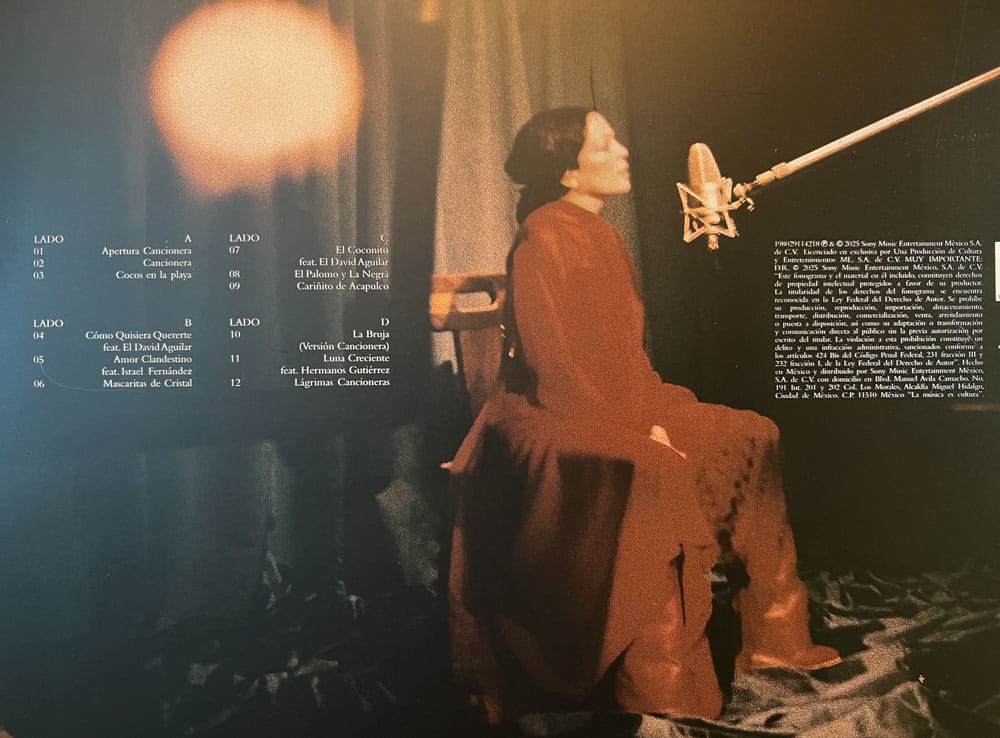
Welcome to what is obviously a celebration—a party of some kind—with Side C’s, Track 2, “El Palomo y La Negra.”
Another example of how this record can place you directly in the scene and make you feel present. As I mentioned near the beginning of this wall of text, all songs were recorded in one take (to tape) and as a result they seem to have an incredible richness and atmosphere. We are in the room with them, at the party.
What is the party for? I get the sense it’s a celebration so maybe a birthday or wedding? It feels like family. It feels like joy. It feels like everyone having a great time as they get drunker and more animated. There are trumpets and a kickin’ Latin beat and a crowd whooping and cheering and singing and whistling and joining in and clapping along. I’ll have what they’re having!
It’s tequila.
The outro is a long section of repeating the refrain:
Rumba que rumba de amor y mezcal
(Rumba, rumba of love and mezcal)
But I’m jumping ahead. The story that comes before that tells a tale of two people who have found each other in love. It is a wedding. It is a celebration. Everyone celebrating these two newlyweds having found their way to this union.
And, you know, an excuse to drink tequila.
In this soundtrack of a record, Side C, Track 3, “Cariñito de Acapulco” makes me think of pure spy music. Or… It’s the bedding track for the opening sequence where we’re flying over the city and introducing an “Elvis in Acapulco”-style movie. Which I will admit is a cliché from me and I only have it my brain because it is literally my only reference for my knowledge of Acapulco. Were those movies even shot there? Cliff divers. Is that Acapulco? I’m so sorry—I grew up on a farm in rural Australia.
If I were on the fence about taking a vacation in Acapulco and you played me this song, I’d get on the plane. Even though my first blush reaction was thinking it would make a good soundtrack to following a character in disguise who’s noodling around the city in airy white linen, I’ll still go. The weather feels quite nice to my ear. I’m taking a nap around 2pm. I’m lazing by the pool with a sunhat on. I’m gonna read so many books in Acapulco!
Enough of this rambling. What’s this song about, really?
According to translate, the title means “Sweetheart of Acapulco.” I’d believe it. This voice has the timbre of a sweetheart. Or wait, is someone else the sweetheart? Now she’s talking about a canoe. Is this sweetheart hanging out with sailors?
It’s not my favorite song on the record. Let’s leave it at that and work on our tan as we sway our hips while walking down to the ocean’s edge on this beach in Acapulco. Aka—let’s move on.
The final flip. “Side D, Track 1, “La Brugja (Version Cancionera)”.
A word or two jumps out at me in this gentle croon, and I don’t know exactly what she’s singing about, but I can tell you, it’s happening in the morning. And… there will be a Mexican mama involved. Ugh. I’ve really got to fire up my Babel App and dig back into those Spanish lessons. Let’s see if I can make it past ¿Qué tal? this time.
Usted! She just said usted! I know you!
Natalia’s vocal practically oozes out of her for this one, and the guitar accompaniment is a partnership made of magic. The combined effect is mystical and rich. I can picture her seated at a campfire, guitar in hand, singing an ancient story to a transfixed audience.
Turns out I might not be that far off with that one.
“La Brugja” translates to ‘The Witch” and this is this cancionera’s (Natalia’s) version of a traditional song. I can’t quite figure out if it’s an actual witch—one that’s hypnotizing people and taking them away (I think?)—or if it’s just the kind of traditional and cultural cautionary tale designed to put the fear of God into kids, so they’ll behave.
Eh, whatever the song’s intent is, the record’s intent is clear to me: Its primary mission is to put me in a warm and toasty mood in my rainy-day cave! Witches an all.
[Insert distant witchy cackle]
Oh, man, have I fallen in love with Side D’s, Track 2, “Luna Creciente.” My friends have a dog called Luna, but come on, even I knew the meaning of the word long before I did any ‘who’s the best girl?’ baby talk to that dog.
Everyone knows Luna means moon. Duh.
So, if luna is moon, what is creciente? Crescent Moon. I’m such a dolt. If I’d thought for even half a second, I could’ve worked that one out.
This song. Oof. The guitar in the intro—the whispers of it as it filters through the room. It’s haunting. It glides, it slips, like moonlight hitting different pieces of furniture in a room as the night progresses.
And then she starts to sing.
When she starts to sing, I can see her. She is standing at a window and looking out at that sliver in the sky, singing to the crescent moon. Some of us howl, but not this lady. She musical note love-bombs.
It’s slow. It’s purposeful. And then the guitar comes back to sing along with her.
Then the song changes pace to lope along for the second verse and if I am to believe the translation, she says “the nights are lonely when you don’t come.”
They are friends, her and Luna. Luna is who she turns to in loneliness, and watching this crescent moon, having this relationship in the night with the moon, she fears each time it goes dark. I don’t know if it’s a waxing crescent moon she’s singing to and she’s singing that she missed it, or a waning moon and she’s sad it’s about to leave.
She sounds so, so effortless and dreamy in her delivery. It’s a lovely little nighttime song about a strange kind of loneliness that is somewhat soothed by that little rock illuminated in our sky.
Just as the instrumental “Apertura Cancionera” opened the most glorious rainy-day record of 2025, (and yes, there were at least two others in contention, and fhe full list of records will be shared on the final day of The Vinyl Countdown) we are gifted another instrumental to close it out.
And once again, it’s total atmospheric slam dunk. I’m talking about Side D’s Track 3, “Lágrimas Cancioneras.”
Another song that feels like it could be in a movie. And it could slot in anywhere in that movie. It makes sense here, since it is the perfect vibe for some closing credits. It feels satisfied with the proceedings, easing us back down to earth with a light and string-rich guiding hand.
The piano and strings just squeeze my lil’ heart. It is a glorious little melody, taken on by multiple instruments as the song progresses. Strings and trumpets and woodwinds. Voices too—the joining in with some swelling and dipping lahs and more to balance out the heavier cellos. It builds and swells. Which fits because…
Lágrimas Cancioneras translates to “Tears of a singer.” And hasn’t this whole record been a meandering through the many emotions of what singing—or a singer—can evoke in humans?
But why is the cancionera crying? Because it’s over, or because she must be moving on?
Well, in this case, the record is over.
Rain. Tears are rain. And this is the perfect rainy-day record.
SEE. WHAT. I. DID. THERE!?
Rain is just sky tears. You get it? Ah, forget it.
Let’s wrap this up. I read a couple of reviews and according to them, this record is not her best work. Not as good as her last, they say. Well, I only have this one to go on and I frickin’ LOVE it. It scratches a specific vibe itch that occasionally needs scratching, and yes, it is usually on a rainy day.
Add it to your playlist and wait for the rain to come. Trust me on this.
I don’t think you need to speak Spanish to enjoy the absolute living shit out of this record, but if you do enjoy it, it might make you wish you could. It might inspire you—like me—to resume those Spanish lessons that you didn’t stick at because you don’t have a single ‘flair for linguistics’ bone in your body.
In truth, I just want to be able to understand. I don’t want to speak. Having said that, I want to order my carne asada burrito from the lovely ladies at my local taqueria and be able to fumble my way through pleasantries with confidence. As it stands now, I haven’t even worked up the nerve to say “gracias” when I pick up from the window.
Pequeños pasos, as they say. Well, if you believe google translate.
Prefer your comment not to be public but still wanna say something? 👇
Go listen (Note: Digital version has two bonus tracks)
Extra Credit
Artist links
Natalia Lafourcade's website
YouTube Channel
Instagram
Interviews and words
"Reimagining Freedom: Natalia Lafourcade Interviewed" - Clash
"Natalia Lafourcade At The Chicago Theatre" - Bearded Gentlemen Music
"Looking to the Past to Find My Future" - NYT (paywall)
"Natalia Lafourcade channels her mystical side in her new album 'Cancionera'" - NPR audio
"Natalia Lafourcade – Cancionera" - The Needle Drop Review
“Natalia Lafourcade Explores Her Alter Ego In ‘Cancionera’: ‘This Album Reaffirmed My Role In Life’” - Billboard